The butter witch of Semlin
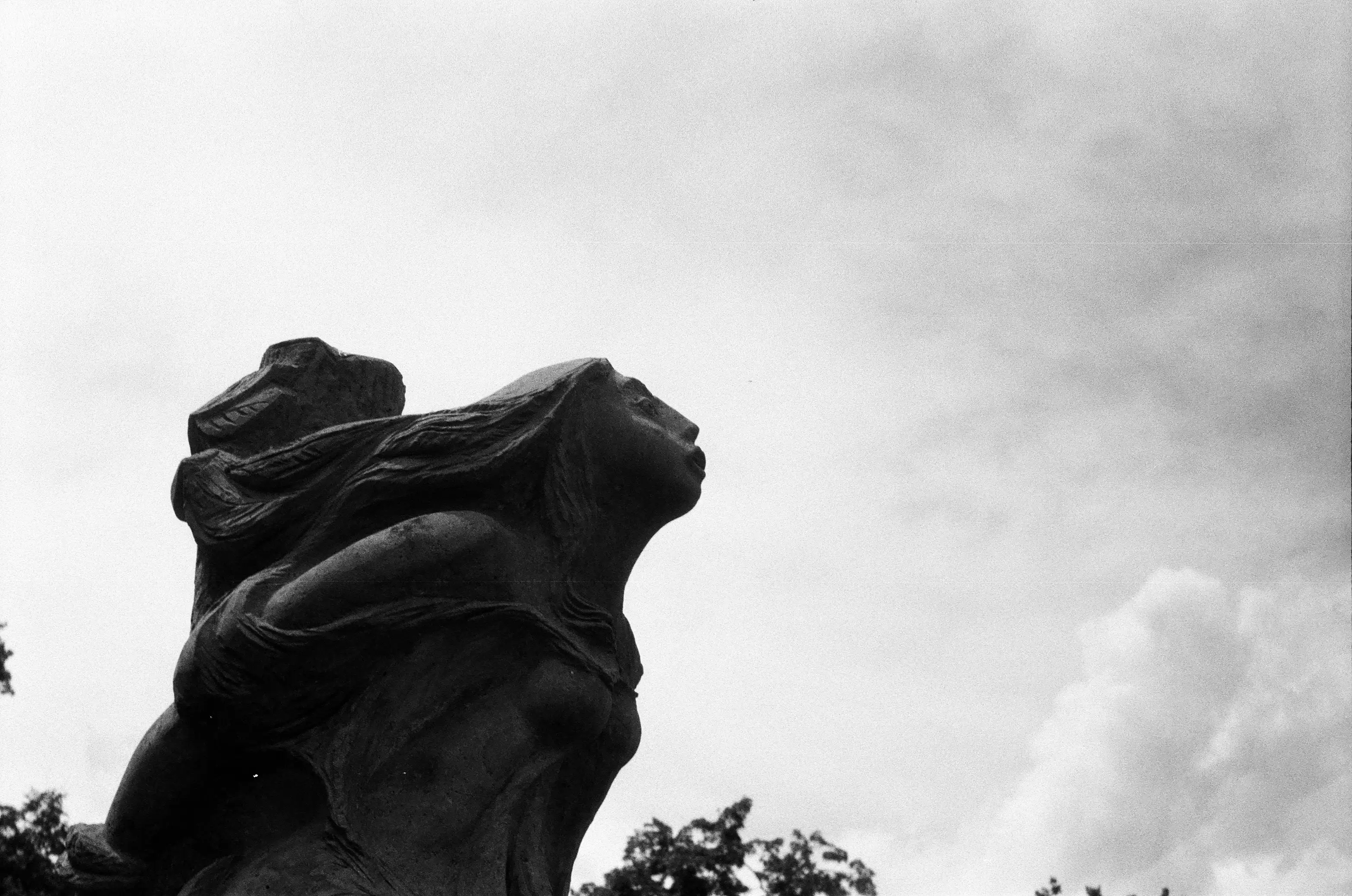
Even if it looks like the statue of a woman is blowing away the clouds, it has a sad background. When I visited Semlin for the first time, I was surprised to find a memorial against the witch hunts: a sandstone sculpture that commemorates Anna Rahns from Semlin, who was interrogated and burned as a “butter witch” in Rathenow in 1672. This was the last witch burning in the town, and the memorial itself was preceded by controversial discussions - including with the Protestant church.1
The reconstructed story of Anna Rahns began before Easter 1672: Anna set off for Ferchesar to sell half a pound of butter. The buyer, linen weaver Andreas Dielaß, sold it the next day to his friend, day laborer Hans Schönemann. He noticed that the butter was full of dirt and hair and brought it back to Dielaß. The dirty butter was then shown around in Ferchesar, and suspicion quickly arose that it was “witch butter.”2
The matter escalated, and the authorities got involved, consulting the Schöppenstuhl in Brandenburg3 to ask if they could “eliminate these evils” and whether they would be allowed to resort to the painful procedure of torture.
Interestingly, no evidence was found in the archives proving that the accused were later tortured or convicted. It is highly likely that Anna Rahns was spared torture and thus a forced confession. By the time the story of the contaminated butter took place, in 1672, the peak of the witch hunts in Havelland had already passed.4
Standing in front of the statue, I couldn’t help but think about how easily suspicion and fear can spiral out of control - even over something as simple as a piece of butter. It’s unsettling to realize that accusations like these could destroy lives, and that the line between superstition and violence was so thin. The memorial feels important, not just as a reminder of Anna Rahns, but as a warning about the dangers of scapegoating and collective hysteria. Even today, it’s easy to see how rumors and prejudice can take hold in a community. I’m glad that Semlin chose to remember this story, rather than let it fade into obscurity.
-
A typical accusation. Dirt and hair in the butter churn, eggs that have been stolen, a poor harvest in your own field while your neighbor has the best fruit, a sudden illness after evil curses had been pronounced. Anyone could be suspected, especially any woman, if she is doing better in the business than others, could very easily be suspected of being a butter witch. Does a woman always have enough butter, even though she does not even have a goat or cow of her own, or does she always have much more hay than her neighbors, even though they have more cattle in the stables, then she is definitely a butter witch. The usual explanation was that the witch gazes into the future or performs a butter prayer and gets the butter from someone else’s churn into her own. The logical explanation that cows and goats are sensitive animals and give more milk if they are milked by someone they know was too far fetched although daily done by dairy maids. Most witch trails were just initiated due the envy of neighbours. ↩︎
-
If a lower court in the Brandenburg province was dealing with such a case, it had to turn to the Schöppenstuhl to obtain a legal opinion. The Brandenburg Schöppenstuhl was made up of several lay judges or Schöppen who had to decide whether harmful magic really existed and what evidence had to be provided for it. ↩︎
-
Detailed information can be found in “Anna Rahns” by Heike Brett and Martin Keune in the Semliner Hefte 7, Semlin 2012. ↩︎