Social Distance (of pigeons)
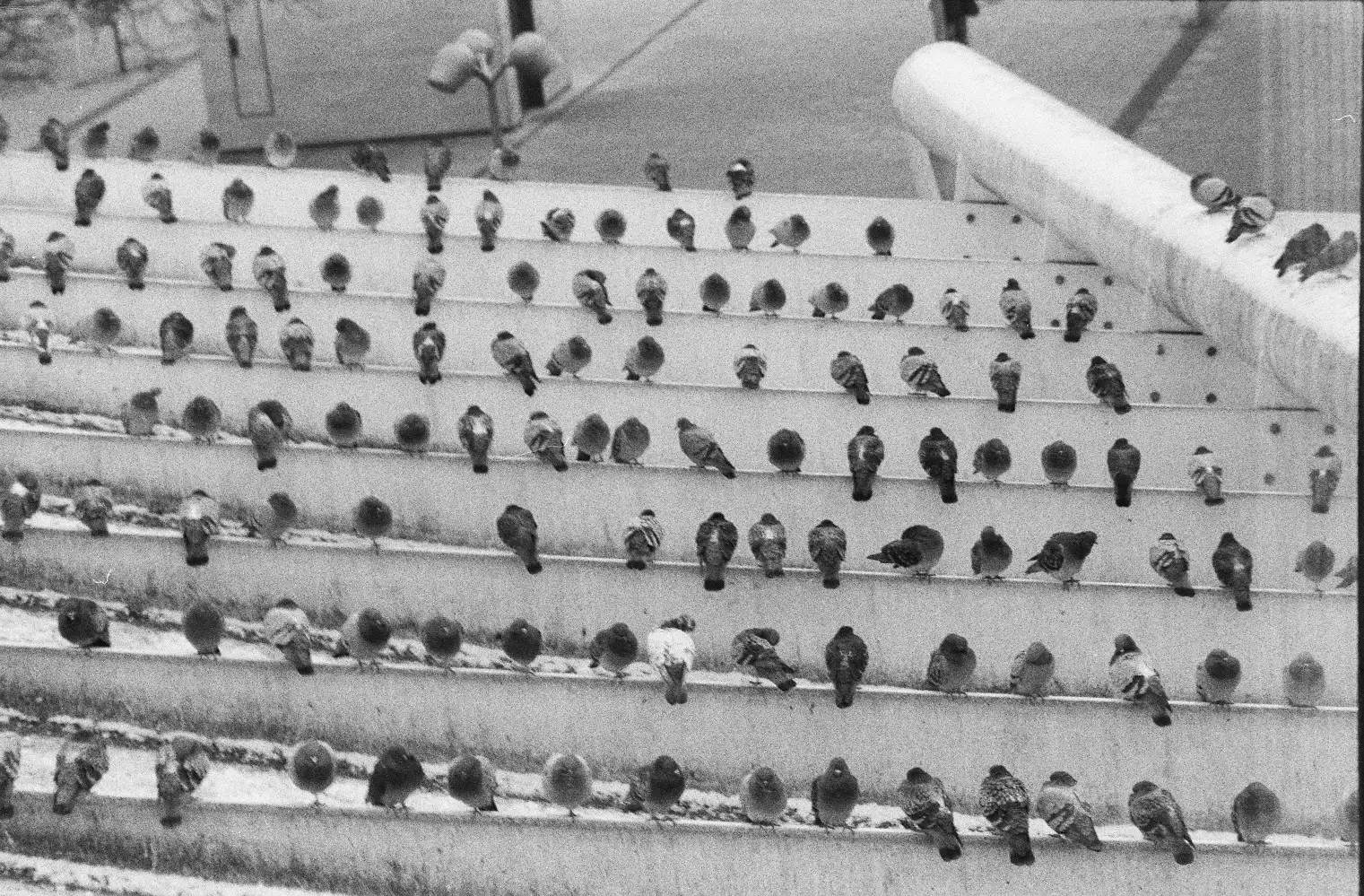
A few weeks ago, I stumbled upon a note in the supermarket: someone was looking for help feeding the pigeons at Bahnhof Lichtenberg. I had never really thought about whether pigeons needed to be fed, so, out of curiosity, I started reading articles and papers about pigeons in Berlin. It turns out this is a surprisingly polarizing topic.
It’s estimated that Berlin has about 10,000 feral pigeons. Recently, a new legal report1 was published examining the legal status of city pigeons as found animals. This report contains some fascinating points. It classifies city pigeons and their offspring as pets - that is, domestic animals - regardless of whether they have escaped or been released. Even after many generations, these pigeons do not lose their typical breeding behavior and do not mix genetically with the wild pigeon species found in Germany. Various scientific studies cited in the report show that the offspring of bred pigeons do not become “feral” either genetically or behaviorally over time. In addition, city pigeons are neither adapted to life in the wild nor suitable for it, due to their breeding, which often leads to poor health and a shorter life expectancy. Urban pigeons typically live only 2–3 years, compared to up to 15 years for well-cared-for domestic pigeons. Their high reproductive rate- a result of selective breeding - often leads to malnutrition and disease in the city environment. Unlike their wild relatives, they lay more eggs, even when food is scarce.
This legal perspective is relatively new and could have significant implications for how cities manage their pigeon populations. If city pigeons are classified as pets, municipalities are obligated to protect them in accordance with Article 20a of the German Basic Law (Grundgesetz) and Section 1 of the Animal Welfare Act (Tierschutzgesetz). Article 20a obliges the state to protect the natural foundations of life and animals, while Section 1 states that no one may cause an animal pain, suffering, or harm without reasonable cause. If city pigeons are considered domestic animals, this creates a legal responsibility for municipalities to ensure their welfare.
One way to protect them is through supervised dovecotes set up around the city, where pigeons are fed and their eggs are exchanged for dummies to reduce the population2. (The Senate is currently looking for suitable locations and potential land for pigeon houses and dovecotes.) This method is widely used in European cities and is considered more humane and effective than culling, as it gradually reduces the population without causing suffering. There is some controversy, however, about whether this method is truly effective3 (but it is still considered better than the alternatives)4.
The biggest controversy, though, seems to be about feeding pigeons. Unlike in many other large cities, feeding pigeons is not forbidden in Berlin. I think it’s important to distinguish between people who feed pigeons for animal welfare reasons and use appropriate food, and those who simply dump their leftovers without any real concern for the animals. Supporters of feeding argue that it helps prevent suffering and disease, while opponents claim it encourages overpopulation and mess. In the end, there is no clear right or wrong - just different perspectives.5
Despite all that, pigeons remain a fascinating subject of study (sometimes in rather bizarre ways6), especially in regard to environmental issues7. Pigeons are “bioindicators” - their health and population trends can reflect the state of the urban environment, including pollution levels, food availability, and the impact of human activity. Like the proverbial canary in a coal mine, changes in pigeon populations may signal broader ecological shifts in the city.
Next time we see a pigeon in the city, maybe we take a moment to consider what its presence says about our urban environment - and our responsibilities within it. Perhaps we should be less agitated by these animals and try to see the bigger picture.
-
Rechtsgutachten Stadttaubenschutz vom 29.10.2021 von Arleth C. und Hübel J. ↩︎
-
Stellungnahme der Berliner Landestierschutzbeauftragten zu drängenden Tierschutzproblemen im Land Berlin – fünf unaufschiebbare tierschutzpolitische Schwerpunkte für den neuen Koalitionsvertrag, 1. November 2021 ↩︎
-
“Es gibt einige Untersuchungen, die zeigen, dass auch Tauben von draußen kommen, sich in den Schlägen vollfressen und dann außerhalb brüten und die Populationen massiv zunehmen. Es ist keine Möglichkeit, die Population zu senken. Es ist aber sicher eine gute Möglichkeit, die Tauben in der Stadt anständig zu halten” - SWR2 Wissen ↩︎
-
https://link.springer.com/article/10.1007/s42977-021-00104-1 ↩︎
-
https://www.spektrum.de/news/taugt-die-taube-zum-vogel-des-jahres/1827304 ↩︎
-
Here and here are some interesting studies to that topic. ↩︎